Key facts
- Who: Candida Royalle, born Candice Marion Vadala, October 15, 1950, Brooklyn, New York; died September 7, 2015, Mattituck, New York (Wikipedia; The New York Times)
- Training: High School of Art and Design, Parsons School of Design and City College of New York (Wikipedia)
- Performer: About 25 films between 1975 and 1980 (Wikipedia)
- Founder: Launched Femme Productions in 1984 to make “adult films from a woman’s perspective,” helping create the couples’ erotica market (Suffolk Times)
- Honors: AVN and XRCO Halls of Fame; Free Speech Coalition Lifetime Achievement Award (1997); her archive is at Harvard’s Schlesinger Library (Wikipedia)
Every time a woman tells me she watches adult content with her partner, or a female director wins an award in my industry, I think of a name most young viewers have never heard: Candida Royalle.
In the early 1980s, the business was made by men, for men. There was one assumed viewer, and everything — the story, the camera, the ending — was built around him. Royalle had been an actress in those films. She looked at them and saw that half the potential audience was being ignored. So she founded her own company and made something different.
I’ve been in this business for 14 years. I’m one of the most-searched male performers in the world, and I’ve worked with most of the top actresses of my generation. A big part of today’s market — couples’ content, female-directed studios, “ethical” and story-driven brands — follows a road that Candida Royalle opened. Here’s the sourced story, and then my take.
A Brooklyn childhood with an empty chair
She was born Candice Marion Vadala on October 15, 1950, into a working-class Catholic family in Brooklyn. Her father, Louis, was a professional jazz drummer with a hot temper. Her mother, Peggy Frazier, left the family when Candice was 18 months old, and she never saw her again. She and her sister Cinthea were raised by their stepmother, Helen Duffy (Wikipedia).
That missing mother followed her for life. As an adult she tracked her down through a private detective; by the time she found her, her birth mother had already died — of ovarian cancer, the same illness that would take Royalle (Cashmere Magazine, citing the New York Post). In 2019 a documentary about that search, Candice, directed by Sheona McDonald, screened at film festivals (Wikipedia).
She trained in music, dance and art in New York and studied at the High School of Art and Design, Parsons School of Design and the City College of New York (Wikipedia). Keep that in mind: this was a woman trained as a designer and an artist before she ever stood in front of an adult camera.
San Francisco, the Cockettes and the camera
After Parsons she moved to California and performed with the Cockettes, the legendary avant-garde theater troupe. In 1975 she played Divine’s daughter in the play The Heartbreak of Psoriasis (Wikipedia). That same period produced music too: a five-track EP she recorded with the electronic producer Patrick Cowley in the mid-1970s was finally released in 2016 as Candida Cosmica (Wikipedia).
Also in 1975 she began acting in adult films, appearing in about 25 of them; the last, in 1980, was one she also wrote and that her then-husband, Per Sjöstedt, produced (Wikipedia). Filmmaker Magazine describes her as an actress of the “golden age” of adult movies who worked in both San Francisco and New York (Filmmaker Magazine).
Why she stopped performing
Wikipedia gives two reasons. The personal one: she had married and was uncomfortable being intimate with other men on camera. The professional one: her feminist views were increasingly at odds with how the films were made — with virtually no attention to the female perspective and no effort to appeal to women viewers (Wikipedia).
She later wrote that “people have always been curious about what sex looks like and how to do it,” but that “one thing was glaringly absent from contemporary pornography: a female vision or point of view” (Wikipedia).
I appreciate that she gave both reasons honestly. Many performers who leave only give the political reason, or only the personal one. Real decisions are usually both.
Club 90: the first support group
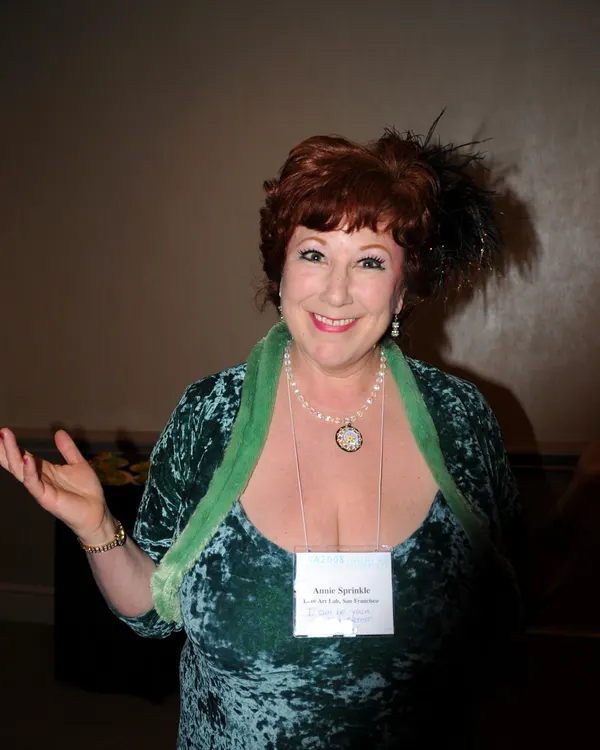
Before she founded her company, she helped found something maybe even more important. In 1983, Royalle, Gloria Leonard, Annie Sprinkle and Veronica Vera started Club 90, the first support group for adult-film actresses (Wikipedia). Filmmaker Magazine describes it as a “tight circle of dear friends,” and in 2015 the CineKink festival held a tribute evening to the group — the last public celebration of Royalle’s work before she died (Filmmaker Magazine).
If you want to know more about the most colorful member of that circle, read my column on Annie Sprinkle, the first porn star with a PhD.
Femme Productions: a business plan in a VCR
The technology mattered. Around 1983, cable TV and home video players were spreading across America. For the first time, people could watch adult films privately at home instead of in a theater — and that meant women and couples could watch too (Wikipedia).
Royalle saw the opening. In early 1984 she founded Femme Productions with Lauren Neimi, with the goal of making erotica based on female desire, including films that could help couples (Wikipedia). In her friend Annie Sprinkle’s words, the idea was “adult films from a woman’s perspective” (Suffolk Times).
The New York Times obituary described her as a “self-styled feminist filmmaker spurning what she called a misogynistic ‘wham, bam, thank you, ma’am’ genre to create erotica that would appeal to women.” She was 30 when she moved from starring in films to producing and directing (The New York Times).
What did “different” mean in practice? Filmmaker Magazine lists it: she described her work as “sensually explicit,” less graphic than typical adult films, and built with storylines, original music and “real characters of all ages” (Filmmaker Magazine). Wikipedia adds that her films were not built around the standard male-centered finale; they placed intimacy inside the emotional and social lives of the women on screen, and counselors and therapists praised them for showing healthy, realistic relationships (Wikipedia).
Proving the market existed
The commercial point is the one people forget. Royalle didn’t only make a statement. She proved there were paying customers. She directed or produced 18 projects, several of them for the big distributor Adam & Eve, which, as Filmmaker Magazine put it, “all serving to demonstrate that a viable audience could be found for adult films appealing to women and couples” (Filmmaker Magazine).
Cashmere Magazine called her “the first major female porn director,” credited with “creating the ‘couple’s porn’ market that caters to a female consumer” (Cashmere Magazine). The Suffolk Times put it simply: she “helped launch the couples’ erotica market” (Suffolk Times).
In 1997 the Free Speech Coalition gave her its Lifetime Achievement Award as a director, and she was inducted into both the AVN and XRCO Halls of Fame (Wikipedia).
Educator, author and free-speech activist
She spoke far beyond the industry: at the Smithsonian Institution, the World Congress on Sexology, universities and professional conferences. She was a member of the American Association of Sex Educators, Counselors and Therapists, a founding board member of Feminists for Free Expression, and wrote columns for adult magazines (Wikipedia). In 2004 she published the book How to Tell a Naked Man What to Do (Wikipedia).
She also wrote for The New York Times. In a 2012 piece she argued: “Pornography can reboot a couple’s sex life. It can give you ideas, or help you get in touch with what turns you on” (Suffolk Times).
Historian Jane Kamensky, who wrote the book Candida Royalle and the Sexual Revolution, told The New York Times that Royalle “is way too critical and self-critical for many of the sex-positive feminists … and she absolutely does not fit into an anti-pornography box.” Kamensky also worked to place her archive — photos, letters, film clips — at Harvard’s Schlesinger Library (Wikipedia).
I think that quote is the best summary of her. She loved what erotic film could be, and she was openly critical of what it usually was. Both at once.
Her last years
Royalle fought ovarian cancer for more than five years. She died on September 7, 2015, at her home in Mattituck, on Long Island, aged 64; her friend Veronica Vera confirmed the cause (The New York Times; Cashmere Magazine). She died surrounded by what Cashmere called “a chosen family of sorts” — Annie Sprinkle, Veronica Vera and attorney Mary Dorman of Feminists for Free Expression (Cashmere Magazine). Memorials were held in New York, Los Angeles and San Francisco (Cashmere Magazine).
What every performer should learn from Candida Royalle
- Look for the audience nobody is serving. She built a business on the viewers the industry ignored.
- Watch the technology. Home video changed who could watch. Today it’s phones and creator platforms. Same lesson.
- Quit for both reasons, and say so. She was honest about the personal and the political.
- Prove it with sales. Her ideas mattered because the films sold.
- Build friendships that outlast the work. Club 90 was still at her bedside 32 years later.
My Take (opinion — Maximo Garcia)
I’ll be honest: I’m a man in this industry, and for most of its history the industry was designed around men like me as the viewer. Candida Royalle is the person who first said, in a way that made money, “you’re forgetting women.” She was right, and she was early. Today, when a studio sells romance, story and chemistry instead of only mechanics, when couples subscribe together, when female directors run brands, they are working inside a market she helped create — even if they’ve never heard her name.
What I respect most, after 14 years doing this, is that she never pretended. She left performing partly because of her marriage and partly because of her politics, and she said both. She defended adult film’s right to exist and criticized how it was usually made. A historian said she didn’t fit into any box. In my experience, the people who change this business never do.
If you’ve ever thought adult content could be better — more honest, more equal, more human — she’s the one who proved it could also be a business. I write more about the history and the realities of this job at maximogarciaworld.com. And if you want to compare her path with a later pioneer, read my column on Joanna Angel and Burning Angel.
👉 More from me at maximogarciaworld.com · Want the full collection? Subscribe at fuckingpornstars.net
FAQ
Who was Candida Royalle?
An American adult-film actress turned producer and director (1950–2015) who founded Femme Productions in 1984 to make erotica from a woman’s perspective for women and couples (Wikipedia; The New York Times).
What was Femme Productions?
The company Royalle founded in early 1984 with Lauren Neimi; she directed or produced 18 titles, several for distributor Adam & Eve, and helped launch the couples’ erotica market (Filmmaker Magazine; Suffolk Times).
What was Candida Royalle’s real name?
She was born Candice Marion Vadala on October 15, 1950, in Brooklyn, New York (Wikipedia).
How did Candida Royalle die?
She died of ovarian cancer on September 7, 2015, at her home in Mattituck, New York, aged 64 (The New York Times).
How we fact-checked this
Every fact and quote was checked against the sources below; where a detail comes from a single outlet (for example the search for her birth mother, reported by the New York Post and cited by Cashmere), it is attributed. Film titles that are themselves explicit were left out. Opinions are Maximo Garcia’s own and are labeled as such.
Sources
- Wikipedia: Candida Royalle — https://en.wikipedia.org/wiki/Candida_Royalle
- The New York Times: “Candida Royalle, 64, Dies; Filmed Erotica for Women” (September 11, 2015) — https://www.nytimes.com/2015/09/11/movies/candida-royalle-maker-of-x-rated-films-dies-at-64.html
- Filmmaker Magazine: “Remembering Candida Royalle, 1950–2015” (2015) — https://filmmakermagazine.com/95607-remembering-candida-royalle-1950-2015/
- The Suffolk Times: “Candida Royalle, feminist erotic filmmaker, dies in Mattituck at 64” (September 2015) — https://suffolktimes.archive.timesreview.com/2015/09/candida-royalle-feminist-pornographic-filmmaker-dies-in-mattituck-at-64/
- Cashmere Magazine: “Feminist porn community mourns the death of pioneer Candida Royalle” — https://cashmeremag.com/candida-royalle-death-154803/